Tag Archives: energy

Copper Oxide Electrospun Nanofibers for Energy

Copper Oxide Nanofibers for Energy

Introduction: The Need for Advanced Materials in the Energy Transition

The global push for cleaner, more efficient energy solutions is reshaping the landscape of materials science. As the world transitions toward renewable energy sources and seeks to reduce carbon emissions, the demand for advanced materials capable of enhancing the performance of batteries, supercapacitors, solar cells, and energy storage devices has reached unprecedented levels. Among these advanced materials, Copper oxide electrospun nanofibers have emerged as a key innovation, offering unique properties and exceptional versatility for next-generation energy applications.

The energy sector’s transformation requires materials that can deliver superior performance while maintaining cost-effectiveness and environmental sustainability. Traditional materials often fall short of meeting the stringent requirements of modern energy devices, creating an urgent need for novel nanomaterials that can bridge this performance gap. Electrospun copper oxide nanofibers are at the forefront of this technological shift, thanks to their outstanding conductivity, catalytic activity, and adaptability.

Why Copper Oxide Nanofibers? Unique Properties for Energy Use

Copper oxide (CuO) stands out as a semiconductor material with several compelling advantages for energy-related applications. Its intrinsic properties make it particularly attractive for various energy conversion and storage technologies.

The fundamental advantages of copper oxide include:

  • High electrical and thermal conductivity: Essential for efficient charge and heat transfer in energy devices
  • Excellent catalytic and photocatalytic activity: Critical for solar energy conversion and environmental applications
  • Low cost and natural abundance: Ensures economic viability for large-scale implementation
  • Ability to form nanostructures with high surface-to-volume ratios: Maximizes active sites for enhanced performance

When CuO is structured as nanofibers through electrospinning, these inherent properties are significantly amplified. The resulting Copper oxide electrospun nanofibers exhibit enhanced characteristics, including increased surface area for greater interaction with electrolytes and reactants, improved electron and ion transport pathways, and porous structures that facilitate diffusion while minimizing mechanical stress during battery cycling operations.

The fibrous morphology also provides mechanical flexibility and structural integrity, making these materials ideal for flexible energy devices and applications requiring durability under mechanical stress. This is why copper oxide electrospun nanofibers are increasingly chosen for advanced energy storage and conversion systems.

Electrospinning as a Route to Create CuO Nanofibers

Electrospinning represents a versatile and scalable technique for producing continuous nanofibers from polymer or inorganic precursor solutions. This process involves applying a high voltage to a solution containing a CuO precursor and a carrier polymer, generating a fine jet that solidifies in air and deposits as a nanofibrous mat on a generally negative charged collector. The electrospinning process is particularly advantageous for producing Copper oxide electrospun nanofibers due to its precise control over fiber morphology and scalability.

The electrospinning process offers several distinct advantages for CuO nanofiber production:

  • Precise control over fiber diameter and morphology: Enables tailoring of material properties for specific applications
  • Ability to incorporate other materials: Facilitates creation of hybrid or composite structures with enhanced functionality
  • Scalability: Adaptable for both laboratory-scale research and industrial-scale manufacturing
  • Cost-effectiveness: Relatively simple setup with moderate equipment requirements

The typical process involves dissolving copper precursors (such as copper acetate or copper nitrate) in a polymer solution, followed by electrospinning under controlled conditions. After electrospinning, the precursor fibers undergo thermal treatment to remove the polymer carrier and yield crystalline copper oxide nanofibers with optimized properties for energy applications. This method ensures high-quality copper oxide nanofibers with the characteristics required for high-performance energy devices.

Energy Applications of CuO Electrospun Nanofibers
Copper oxide electrospun nanofibers have demonstrated outstanding performance across a diverse range of energy applications, driving significant innovation in both energy storage and conversion devices. The use of copper oxide electrospun nanofibers in these fields is rapidly expanding due to their superior electrochemical and structural properties.

Electrospun Copper Oxide Nanofibers for Energy Storage

Advantages in Battery and Supercapacitor Design
In lithium-ion batteries, CuO nanofibers offer exceptional electrochemical performance characteristics. The fibrous morphology provides stable reversible capacity and excellent cycling performance over extended periods. Recent studies have demonstrated that CuO nanofibers produced by electrospinning can achieve specific capacities up to 452 mAh/g while maintaining stable performance over 100+ charge-discharge cycles. This remarkable performance is attributed to the unique structure of copper oxide electrospun nanofibers, which significantly outperforms conventional materials.

The one-dimensional structure of the nanofibers facilitates rapid lithium-ion diffusion and provides excellent electronic conductivity pathways. Additionally, the porous nature of the fibrous network accommodates volume changes during lithium insertion and extraction, reducing mechanical degradation and extending battery life.

For supercapacitors, the porous, conductive network of CuO nanofibers enables rapid charge transfer and higher energy density compared to traditional electrode materials. The high surface area provides numerous active sites for charge storage, while the interconnected fibrous structure ensures efficient electron transport. Integrating these nanofibers into hybrid electrodes has shown to enhance both power density and device longevity significantly. These advantages make Copper oxide electrospun nanofibers a preferred choice for next-generation supercapacitors.

Nanofibers for Photocatalysis and Solar Energy

Copper oxide nanofibers excel in photocatalytic applications and solar energy conversion systems. Their semiconductor properties enable efficient absorption of visible light and generation of electron-hole pairs, making them ideal for multiple applications including photocatalytic degradation of organic pollutants, hydrogen production via water splitting, and integration into photodetectors and next-generation solar cells.

The high surface area and tunable architectures of Copper oxide electrospun nanofibers further enhance process efficiency by providing more active sites for photocatalytic reactions.

The fibrous structure also facilitates better light scattering and absorption, improving overall photocatalytic performance. These properties open new avenues for solar energy utilization and environmental remediation applications.

Key Material Combinations and Hybrid Nanostructures

The performance of copper oxide electrospun nanofibers can be significantly enhanced by combining them with other materials to create sophisticated hybrid or composite structures. Hybrid electrodes based on Copper oxide electrospun nanofibers and other nanomaterials are being developed to achieve superior energy storage and conversion performance.

Notable examples of hybrid nanostructures include copper nanofiber networks with cobalt oxides (CuNFs@CoOx), which demonstrate improved electrode conductivity and mechanical stability, leading to higher capacity and better cycling performance in lithium-ion batteries. The cobalt oxide coating provides additional active sites while protecting the copper core from oxidation.

Core-shell and multilayer nanofiber designs represent another promising approach, optimizing electron transfer and ion diffusion while protecting the active material from degradation. These architectures can be precisely controlled during the electrospinning process by adjusting solution properties and processing parameters.

Composites incorporating graphene, metal oxides, or conductive polymers expand the range of applications and improve efficiency in both storage and conversion devices. For instance, CuO-graphene composites combine the high surface area of CuO nanofibers with the excellent electrical conductivity of graphene, resulting in enhanced electrochemical performance.

Such nanostructured material engineering strategies provide unprecedented opportunities for developing customized, high-performance energy devices tailored to specific application requirements.

copper oxide benefits

Benefits of Copper and Magnesium Cosubstitution in Na0.5Mn0.6Ni0.4O2 as a Superior Cathode for Sodium Ion Batteries. Source: Tao ChenWeifang LiuFang LiuYi LuoYi ZhuoHang HuJing GuoJun Yan*Kaiyu Liu*

Challenges, Industrial Scalability, and Fluidnatek’s Role

Despite significant scientific progress, integrating copper oxide electrospun nanofibers into industrial applications presents several critical challenges that must be addressed for successful commercialization. The large-scale production of Copper oxide electrospun nanofibers requires robust process control and advanced manufacturing solutions.

Scalability remains a primary concern, as large-scale production requires robust electrospinning systems capable of delivering high volumes of nanofibers with consistent quality and reproducible properties. The transition from laboratory-scale to industrial-scale production demands sophisticated process control and monitoring systems.

Uniformity and property control represent another significant challenge, as ensuring homogeneity in fiber diameter, morphology, and composition across large production batches is critical for commercial device performance. Variations in these parameters can significantly impact the final device performance and reliability.

Device integration requires efficient assembly of nanofibers into electrodes and functional components, demanding specialized engineering solutions and manufacturing processes that can handle the delicate nature of nanofibrous materials while maintaining their structural integrity.

Fluidnatek stands at the forefront of addressing these challenges through advanced electrospinning technology. The company offers sophisticated platforms specifically designed for scalable, controlled production of copper oxide nanofibers tailored for energy applications.

Fluidnatek’s systems are engineered to enable the industrial adoption of copper oxide electrospun nanofibers, bridging the gap between laboratory innovation and commercial-scale manufacturing

Conclusion: Copper Oxide Electrospun Nanofibers—The Future of Advanced Energy Materials

Copper oxide electrospun nanofibers represent one of the most promising solutions for next-generation energy devices, offering a unique combination of properties that address multiple challenges in energy storage and conversion. The continued development and deployment of copper oxide electrospun nanofibers will be key to advancing energy technologies worldwide.

Their exceptional surface area, excellent electrical conductivity, and structural versatility make them ideal candidates for advanced batteries, supercapacitors, photocatalytic systems, and solar energy conversion devices.

The ability to engineer hybrid and composite structures further expands their potential applications and performance capabilities, opening new possibilities for customized energy solutions. As the energy sector continues to evolve toward more sustainable and efficient technologies, these nanomaterials will play an increasingly important role in enabling the next generation of energy devices.

The primary challenges of scalability and quality control can be effectively addressed through advanced electrospinning technologies. Success in overcoming these challenges will unlock the full potential of copper oxide nanofibers and accelerate their industrial adoption across various energy applications.

Ready to Accelerate Your Energy Innovation?

Interested in scalable production of copper oxide nanofibers for energy devices? Discover how Fluidnatek’s electrospinning platforms empower energy innovation and enable the transition from laboratory research to industrial manufacturing.

Let Fluidnatek help you move from lab-scale research to commercial production with reliable, high-performance nanofiber solutions specifically tailored for the future of energy technology.

References

  1. Li, D., & Xia, Y. (2004). Electrospinning of nanofibers: Reinventing the wheel? Advanced Materials, 16(14), 1151-1170. https://doi.org/10.1002/adma.200400719
  2. Li, X., et al. (2021). Electrospun copper oxide nanofibers for high-performance lithium-ion batteries. Journal of Power Sources, 482, 228949. https://doi.org/10.1016/j.jpowsour.2020.228949
  3. Wang, Y., et al. (2017). Electrospun CuO nanofibers for high-performance supercapacitors. Nano Energy, 32, 294-301. https://doi.org/10.1016/j.nanoen.2016.12.015
  4. Zhang, X., et al. (2019). Recent advances in copper oxide nanostructures for energy applications. ACS Applied Energy Materials, 2(2), 1420-1440. https://doi.org/10.1021/acsaem.8b01909
  5. Fluidnatek by Bioinicia. (2025). Electrospinning technology for functional nanomaterials. https://fluidnatek.com/electrospinning-electrospraying/


Electrospun Membrane in Batteries: Enhancing Performance and Efficiency

Electrospun Membrane in Batteries

The demand for high-performance energy storage solutions is rapidly increasing, driving innovation in battery technology. One promising approach involves the use of electrospun membranes in batteries to enhance its performance and efficiency.

With this purpose in mind, this article explores the role of electrospinning in battery technology, the benefits of electrospun membranes, and future perspectives in this exciting field.

The Role of Electrospinning in Battery Technology

Electrospinning has emerged as a pivotal technique in the development of advanced battery technologies due to its ability to produce nanofiber membranes with tailored properties. Particularly, these membranes, which can serve as separators, electrode materials, or composite structures, are characterized by their high surface area, porosity, and tunable morphology.

By adjusting parameters such as fiber diameter, pore size, and material composition during the electrospinning process, researchers can optimize the performance of these membranes for specific battery applications. For instance, the controlled porosity of electrospun separators enhances ion transport while maintaining mechanical stability, which is crucial for safety and performance in -ion batteries.

Additionally, electrospinning enables the incorporation of functional materials like doped polymers or metal oxides into the fibers, further improving conductivity and thermal stability. Subsequently, this versatility positions electrospinning as a cornerstone for innovation in energy storage solutions.

Electrospun Membranes for Next-Generation Batteries

Certainly, Electrospun membranes are at the forefront of next-generation battery research due to their ability to address key challenges such as energy density, power output, and longevity.

In fact, these membranes are particularly promising for advanced battery chemistries like lithium-sulfur and lithium-air systems. In lithium-sulfur batteries, electrospun separators with enhanced electrolyte retention and polysulfide-trapping capabilities significantly improve cycling stability.

Similarly, in lithium-air batteries, the use of electrospun cathodes provides a highly porous structure that facilitates oxygen diffusion and reaction kinetics, resulting in better efficiency and durability.

Furthermore, multilayered or composite electrospun membranes offer multifunctionality by combining mechanical strength with thermal resistance and ionic conductivity. hence, this adaptability allows for the creation of customized solutions tailored to the demands of emerging battery technologies.

As research progresses, the integration of advanced materials into electrospun fibers is expected to unlock even greater performance gains, paving the way for more efficient and sustainable energy storage systems.

Electrospun materials in Batteries: A Revolution in Energy Storage

The use of electrospun materials in batteries represents a revolutionary advancement. Moreover, the unique properties of electrospun nanofibers, such as high surface area and porosity, facilitate faster ion transport and improved electrode-electrolyte contact. Therefore, this results in batteries with enhanced performance characteristics.

Electrospun Cathode for Lithium Air Battery: Applications and Benefits

One particularly promising application is the use of an electrospun cathode for lithium air battery. Lithium-air batteries have the potential for extremely high energy density, but they face challenges related to cathode performance.

Overall, Electrospun cathodes can improve the battery’s efficiency, lifespan, and stability by providing a highly porous and interconnected structure that facilitates oxygen transport and reaction.

Lithium-ion industrial high current batteries

Lithium-ion industrial high current batteries.

Advantages of Electrospun Membranes in Battery Performance

Unquestionably, Electrospun nanofiber membranes for lithium-ion batteries offer several key advantages:

  • Improved Ion Conductivity: The porous structure of electrospun membranes allows for faster ion transport, leading to higher power output.
  • Enhanced Electrolyte Retention: Electrospun membranes can effectively retain the electrolyte, ensuring good ionic contact between the electrodes.
  • Increased Surface Area: The high surface area of electrospun anode materials and electrospun cathode materials provides more active sites for electrochemical reactions, improving energy storage capacity.
  • Better Mechanical Properties: Electrospun membranes can be designed with good mechanical strength and flexibility, enhancing the battery’s durability.
  • Customizable Morphology: The electrospinning process allows for precise control over the membrane’s pore size, fiber diameter, and composition, enabling tailored solutions for specific battery requirements. Electrospun nanofiber battery separators also benefit from this.

Future Perspectives in Electrospinning for Battery Development

Subsequently, the future of electrospinning in battery technology looks bright, with ongoing research focused on:

  • Developing new electrospun anode materials and electrospun cathode materials: Exploring novel materials to further enhance battery performance.
  • Optimizing the electrospinning process: Fine-tuning parameters to achieve even greater control over membrane properties.
  • Creating multi-functional membranes: Combining different functionalities within a single electrospun membrane to improve overall battery performance.
  • Scaling up production: Developing cost-effective methods for mass production of electrospun membranes.

Conclusion

Summing up, Electrospun membranes are poised to play a significant role in the future of battery technology. Their unique properties and versatility make them an ideal solution for enhancing the performance and efficiency of next-generation batteries. To point out, the development of the electrospun cathode for lithium air battery is just one example of the exciting possibilities offered by this technology.

Interested in leveraging electrospun membranes for high-performance battery applications? Contact our experts at Fluidnatek to explore tailored solutions. Learn more about our advanced electrospinning technology on our applications page.

References

  1. Preparation of Electrospun Membranes and Their Use as Separators in Lithium BatteriesBatteries, 2023, 9(4), 201; DOI: 10.3390/batteries90402011.
  2. Electrospun Lithium Metal Oxide Cathode Materials for Lithium-Ion BatteriesRSC Advances, 2013; DOI: 10.1039/c3ra45414b2.
  3. Electrospun Cellulose Nanofiber Membranes as Multifunctional Separators for High Energy and Stable Lithium-Sulfur BatteriesEnergy Engineering and Power Technology, 2023; DOI: 10.1155/2023/15418583.
  4. Electrospun Nanofibers Enabled Advanced Lithium–Sulfur BatteriesAccounts of Materials Research, 2022; DOI: 10.1021/accountsmr.1c001984.
  5. Advances in Electrospun Materials and Methods for Li-Ion BatteriesBatteries, 2023; DOI: 10.3390/batteries90402015.
  6. Electrospun Nanofiber Electrodes for LithiumIon BatteriesMacromolecular Rapid Communications, 2022; DOI: 10.1002/marc.2022007406.
  7. A Review of Electrospun Separators for LithiumBased BatteriesChemElectroChem, 2022; DOI: 10.1002/cey2.5397

Electrospinning Techniques for Energy Generation and Storage

electrospinning-energy-generation-storage

Electrospinning is widely recognized for its role in nanofiber production, but it also holds potential for energy generation. This article explores how electrospinning contributes to energy applications.

Nanogenerators and Energy Harvesting

One of the most promising applications of electrospinning in the energy sector is in the development of nanogenerators. These devices harness mechanical energy and convert it into electrical energy, making them useful for powering small electronic devices and wearable technology.

Nanogenerators rely on electrospun nanofibers to enhance their energy-harvesting capabilities. These fibers improve the surface area and mechanical properties of the generator, making energy conversion more efficient.

Some of the most common types of nanogenerators include:

  • Piezoelectric nanogenerators (PENGs): Convert mechanical stress into electrical energy.
  • Triboelectric nanogenerators (TENGs): Utilize contact electrification to generate power.

Recent advancements in electrospinning techniques have significantly improved nanofiber production and applications in various fields. Crystal engineering has emerged as a promising approach to create oriented crystal LiMPO4/carbon nanofiber hybrids, enhancing lithium storage and transfer capabilities in battery applications. This technique allows for the fabrication of high-performance electrodes without polymeric binders, resulting in improved capacity retention and discharge rates.

These types of nanogenerators depend on high-quality nanofibers, which can only be produced using a stable and reliable electrospinning power supply.

Scanning Electron Micrographs (SEMs)

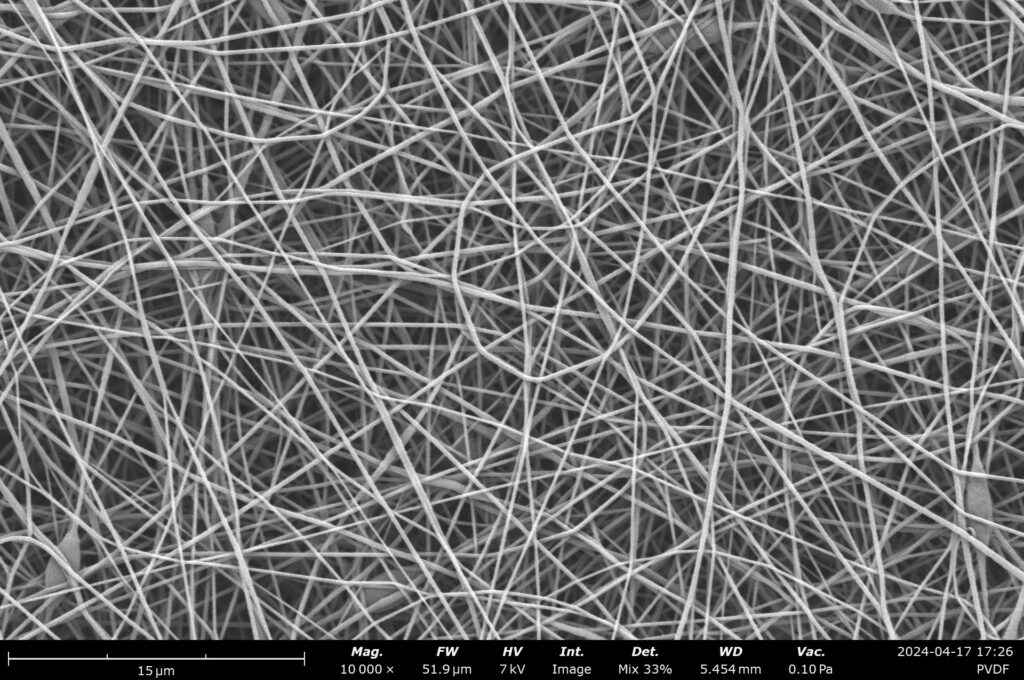
Scanning Electron Micrographs (SEMs) of different nanofibers structures.

Fuel Cells and Battery Applications

Electrospun nanofibers are also being used to enhance energy storage devices, such as batteries and fuel cells. These fibers increase electrode surface area, improve conductivity, and enhance ion transport efficiency, leading to better overall performance.

Recent advancements in electrospinning techniques have enabled the fabrication of high-performance electrodes without polymeric binders, improving capacity retention and discharge rates.

One notable innovation in this area is the development of continuous gradient composite films (GCFs) using dynamic concentration adjustment techniques combined with electrospinning. These films exhibit a gradient distribution of nanoparticles within the carbon fiber matrix, significantly enhancing electronic conductivity and electrochemical performance. Such an approach is particularly promising for cathode development in aqueous zinc-ion batteries, offering improved efficiency and stability.

Further advancements in near-field electrospinning technology have also contributed to precise fiber deposition in energy storage applications. By reducing the spinning distance and voltage, near-field electrospinning enables high-precision jet control, allowing for the accurate deposition of cured fibers. When integrated with a precise motion platform, this technique facilitates the formation of aligned fibers with predesigned topologies, unlocking new possibilities for optimizing electrode architectures and improving battery performance.

Experimental procedures and configurations

Experimental procedures and configurations. (A) The synthesis of zeolitic imidazolate framework (ZIF)-8 nanocrystals and the fabrication of electrospun ZIF/polyacrylonitrile (PAN) nanofibrous mats. (B) A contact-separation triboelectric nanogenerator (TENG) device utilizing the ZIF/PAN nanofibrous mat as the electropositive triboelectric material. (C) Schematic representation of the proposed rotary TENG device operating in rolling mode [Tabassian et al., 2024].

Optimizing Electrospinning for Energy Applications

To achieve the best results in energy-related electrospinning applications, researchers must carefully optimize process parameters. Some key factors include:

1. Polymer Selection

Choosing the right polymer is essential for maximizing the electroactive properties of nanofibers used in energy devices. Popular choices include:

  • Polyvinylidene fluoride (PVDF) for piezoelectric applications
  • Polyaniline (PANI) for conductive fiber production

Additionally, blending different polymers or incorporating nanomaterials such as carbon nanotubes or graphene can significantly improve electrical and mechanical properties. This allows for more efficient energy harvesting and storage applications, further expanding the potential of electrospun fibers in sustainable energy solutions.

2. Solution Viscosity

The concentration and viscosity of the polymer solution affect fiber diameter and uniformity. Achieving the right balance ensures the best performance in energy devices. High-viscosity solutions tend to form thicker fibers, while low-viscosity solutions may produce beads rather than continuous fibers. Researchers often experiment with different solvent compositions to optimize viscosity and ensure defect-free fiber production. The choice of solvent also impacts the drying rate and overall fiber morphology, making it a critical factor in the electrospinning process.

3. Collector Type

Using a rotating drum or a conductive substrate as the fiber collector can help align nanofibers for specific energy applications, improving their efficiency in devices like batteries and nanogenerators. Additionally, adjusting the collector speed and shape can influence fiber alignment and density. Recent advances in electrospinning technology have enabled the development of patterned collectors that further enhance fiber organization, leading to improved charge transport in energy storage applications. Properly aligning nanofibers can increase conductivity and energy efficiency, making them more viable for industrial applications.

Advancements in collector technology have expanded the range of possible nanofiber structures and morphologies. Innovative collector designs now enable the production of defect-free nonwoven sheets, tubular structures, continuous yarns, and fine coatings on various substrates. These advancements allow researchers and manufacturers to tailor a sample’s microstructure to meet specific application requirements, further enhancing the versatility of electrospun materials.

Rotating drum collector.

Rotating drum collector.

Importance of a Reliable Electrospinning Power Supply

A stable electrospinning power supply is critical for ensuring the uniformity and consistency of electrospun nanofibers. Several factors must be considered when selecting a power source for electrospinning:

1. Voltage Stability

Voltage fluctuations can lead to inconsistencies in fiber morphology, affecting their electrical and mechanical properties. A high-precision power source for electrospinning ensures uniform fiber production.

2. Adjustable Voltage Range

Different polymers and applications require different voltage settings. An adjustable electrospinning power supply allows researchers to fine-tune the process for optimal fiber formation.

3. Safety Features

Since electrospinning involves high voltages, choosing a power supply with built-in safety mechanisms, such as current limits and overload protection, is crucial for laboratory and industrial applications.

Future Perspectives in Electrospinning and Energy Harvesting

The use of electrospinning in energy applications is an exciting area of research with the potential to revolutionize energy harvesting and storage.

As research continues, electrospinning will likely play an even greater role in energy-related applications. Advances in polymer chemistry, and process optimization will lead to more efficient and scalable energy solutions.

Electrospun fibers are transforming energy storage and power generation with their advanced capabilities. At Fluidnatek, we deliver state-of-the-art electrospinning technology for next-generation applications. Discover how our innovative solutions can elevate your power supply—contact us today!

Author
Wee-Eong TEO

References:

Electrospinning Technology and Its Energy Applications

Adachi M, Murata Y, Takao J, Jiu J, Sakamoto M, Wang F. Highly efficient dye-sensitized solar cells with a titania thin-film electrode composed of a network structure of single-crystal-like TiO2 nanowires made by the “oriented attachment” mechanism. J Am Chem Soc 2004; 126: 14943.

Al-Dhubhani E, Tedesco M, Vos W M, Saakes M. Combined Electrospinning-Electrospraying for High-Performance Bipolar Membranes with Incorporated MCM-41 as Water Dissociation Catalysts. ACS Appl. Mater. Interfaces 2023; 15: 45745.

Al-Enizi A M, Karim A, Yousef A. A novel method for fabrication of electrospun cadmium sulfide nanoparticles-decorated zinc oxide nanofibers as effective photocatalyst for water photosplitting. Alexandria Engineering Journal 2023; 65: 825.

Hamadanian M, Jabbari V. Improved conversion efficiency in dye-sensitized solar cells based on electrospun TiCl4-treated TiO2 Nanorod electrodes. International Journal of Green Energy 2014; 11: 364.

Shafii C. Energy Harvesting Using PVDF Piezoelectric Nanofabric. MSc Thesis. University of Toronto 2014

INTERESTED? CONTACT OUR SPECIALISTS!