Tag Archives: water treatment

Electrospun Membrane for Textile Wastewater Treatment

Electrospun Membranes for Textile Wastewater

Introduction – The Challenge of Textile Wastewater

The textile industry is widely recognised as one of the most water-intensive manufacturing sectors. Dyeing and finishing operations generate substantial quantities of effluents containing complex mixtures of synthetic dyes, salts, surfactants, heavy metals, and auxiliary chemicals. These waste streams are particularly persistent due to their high chemical oxygen demand (COD), colour intensity, and the presence of recalcitrant organic molecules such as azo dyes.International organisations, including the World Bank, have identified textile dyeing and finishing processes as major contributors to industrial water pollution, especially in regions with concentrated manufacturing activity. The persistence and toxicity of certain dyes raise environmental and public health concerns, particularly when wastewater treatment infrastructure is insufficient.

Conventional treatment technologies — coagulation–flocculation, biological oxidation, activated carbon adsorption, advanced oxidation processes (AOPs), and membrane filtration — can reduce pollutant loads but often present trade-offs. These include high operational costs, secondary sludge generation, limited removal efficiency for low-molecular-weight dyes, and membrane fouling challenges.

As regulatory standards become more stringent and water reuse strategies gain importance within circular economy frameworks, there is increasing interest in advanced materials capable of enhancing separation efficiency while maintaining scalability. In this context, the electrospun membrane for textile wastewater treatment has emerged as a promising platform within nanofiber membrane technology.

Electrospun Nanofiber Membranes – A New Frontier in Filtration

Electrospinning is a fibre fabrication technique that employs a high-voltage electric field to draw ultrafine fibres from polymer solutions or melts. The resulting nanofiber membranes consist of nonwoven mats with fibre diameters typically ranging from tens of nanometres to several micrometres.

These membranes are characterised by:

  • High porosity (often exceeding 80%)
  • Interconnected pore structures
  • Large specific surface area
  • Tunable fibre diameter and thickness

Key structural advantages

High surface-area-to-volume ratio
The nanoscale diameter of electrospun fibres significantly increases the available surface area, enhancing adsorption interactions with dissolved pollutants such as dyes and metal ions.

Interconnected porous structure
The open, porous morphology enables high permeability compared to dense phase-inversion membranes, facilitating improved water flux under comparable pressure conditions.

Tailorable surface chemistry
Electrospun membranes can be functionalised either during spinning (by polymer blending or nanoparticle incorporation) or post-treatment (plasma, grafting, coating), allowing optimisation for specific wastewater compositions.

In contrast to conventional membranes governed predominantly by size exclusion, electrospun nanofiber membranes offer a versatile platform for integrating adsorptive, sieving, and catalytic functionalities, dictated by their specific material composition and functionalization strategies

Materials Used for Electrospun Membranes in Water Treatment

Material selection plays a decisive role in mechanical stability, chemical resistance, hydrophilicity/hydrophobicity balance, and pollutant interaction.

Polyvinylidene fluoride (PVDF) nanofiber membranes

PVDF is widely used in membrane engineering due to its:

  • Chemical resistance
  • Thermal stability
  • Mechanical robustness

Despite its robust mechanical properties, PVDF exhibits intrinsic hydrophobicity. For aqueous textile wastewater treatment, surface modification or blending with hydrophilic additives is often necessary to improve wettability and reduce fouling.

Studies published in journals such as Separation and Purification Technology and Journal of Membrane Science report effective dye rejection when PVDF electrospun membranes are modified or combined with functional nanoparticles.

Incorporation of photocatalytic fillers such as TiO₂ can enable additional degradation mechanisms under UV irradiation, contributing to colour removal beyond simple filtration.


Polyacrylonitrile (PAN) and polyamide membranes

Polyacrylonitrile (PAN) is frequently used in electrospinning due to:

  • Good spinnability
  • Mechanical strength
  • Reactive nitrile groups

The nitrile functionality can be chemically modified to introduce amine or carboxyl groups, improving affinity for heavy metal ions such as Cu²⁺ or Pb²⁺ through coordination mechanisms.

Functionalised PAN nanofiber membranes have demonstrated promising adsorption capacities for heavy metals and certain dye classes in laboratory-scale studies.


Composite and hybrid membrane architectures

Recent research trends focus on multifunctional composite membranes, where electrospun fibres act as a support or active layer integrating nanomaterials.

Examples include:

  • PVDF/TiO₂ nanofibers for photocatalytic dye degradation
  • PAN/graphene oxide composites enhancing adsorption performance
  • Chitosan-based nanofibers offering inherent affinity for anionic dyes
  • Cellulose acetate electrospun membranes for more sustainable polymer options

These hybrid strategies enable the design of multifunctional membranes that synergistically combine physical sieving with chemical adsorption or catalytic degradation.


Case Example – Poly-CD Nanofibrous Membranes

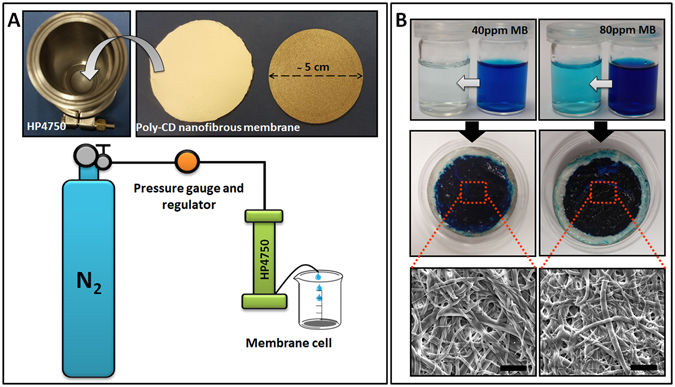
A study by Celebioglu et al. (2017) investigated poly-cyclodextrin (poly-CD) electrospun nanofibrous membranes for dye removal applications.

Using a dead-end filtration system (HP4750), methylene blue (MB) solutions at concentrations of 40 and 80 mg/L were filtered under controlled nitrogen pressure. The study reported:

  • Significant colour reduction in permeate solutions
  • Preservation of nanofibre morphology after filtration
  • Mechanical stability under applied pressure

SEM analysis confirmed that the fibrous structure remained intact, demonstrating that properly engineered nanofibrous membranes can withstand operational stress conditions while maintaining adsorption functionality.

This example highlights the importance of polymer chemistry and structural stability in practical filtration environments.


Advantages in Textile Wastewater Remediation

Electrospun membranes offer several potential advantages over conventional polymeric membranes and adsorption media.

Enhanced Pollutant Interaction

The nanoscale fibre diameter increases the likelihood of contact between pollutants and active sites, supporting improved adsorption-driven removal mechanisms.

High Permeability

Due to their high porosity and interconnected structure, electrospun membranes often exhibit elevated permeability compared to dense membranes fabricated via phase inversion. Several comparative studies report substantially higher water flux values, although performance depends on membrane thickness and operational pressure.

Functionalisation Flexibility

Electrospinning enables the incorporation of nanoparticles, adsorptive fillers, and catalytic agents directly into the fibre matrix. This flexibility supports the development of application-specific membranes tailored to particular textile effluent compositions.

Potential Integration into Multistage Systems

Electrospun membranes can function as:

  • Standalone filtration layers
  • Support structures in composite membrane assemblies
  • Pretreatment stages before reverse osmosis
  • Adsorptive polishing units

Such versatility makes them attractive for modular wastewater treatment strategies.
Filtration performance of poly-CD nanofibrous membrane

Filtration performance of poly-CD nanofibrous membrane. (A) The photographs of membrane cell part of HP4750 dead-end system and the cropped poly-CD nanofibrous membrane with a definite active filtration area (14.6 cm2). The schematic view of HP4750 filtration system. For each test, 50 mL solution is passed through the poly-CD nanofibrous membranes with a definite N2 pressure. Then, the permeated solution is collected in a clear beaker. (B) The visual illustration of the MB solutions prepared at two different MB concentrations (40 and 80 mg/L) before and after filtration test. The photographs and SEM images (scale bar-10 µm) of the poly-CD nanowebs exposed to these two concentrated MB solutions during the experiments. As clearly seen, both the macroscopic visual appearance and the fibrous morphology of poly-CD nanofibers were protected under such applied pressure [Celebioglu et al 2017].

Research Trends and Industrial Considerations

While numerous studies demonstrate laboratory-scale feasibility, challenges remain in translating electrospun nanofiber membranes to full industrial deployment.

Key considerations include:

  • Long-term fouling resistance
  • Mechanical durability under continuous flow
  • Chemical stability in highly saline or alkaline effluents
  • Reusability and regeneration cycles
  • Production scalability

Recent publications in Journal of Membrane Science, Desalination, and Water Research emphasise the need for robust scale-up strategies and standardised testing protocols to enable commercial adoption.

Role of Fluidnatek in Scalable Membrane Development

Scaling electrospun membranes from laboratory prototypes to industrial production requires advanced electrospinning platforms capable of maintaining fibre uniformity and reproducibility.

Fluidnatek provides electrospinning equipment designed for:

  • Controlled fibre diameter distribution
  • Multi-nozzle and free-surface electrospinning
  • Integration of functional fillers
  • Pilot and industrial-scale membrane manufacturing

By supporting both research and scale-up stages, Fluidnatek’s platforms enable development of nanofiber membranes for water treatment applications, including textile wastewater remediation.

More information on electrospinning technologies for separation applications can be found at: https://www.fluidnatek.com

Conclusion – Towards Sustainable Textile Wastewater Treatment

Textile wastewater represents a recalcitrant effluent stream, characterized by significant chemical complexity and inherent variability. While traditional treatment technologies facilitate partial remediation, they frequently exhibit insufficient removal efficiencies for persistent synthetic dyes and dissolved contaminants.

Electrospun nanofiber membranes represent a promising material platform capable of enhancing separation efficiency through high porosity, tunable surface chemistry, and multifunctional design. Laboratory studies demonstrate effective dye adsorption, heavy metal capture, and potential photocatalytic degradation when appropriate materials are employed.

Despite successful laboratory demonstrations, transitioning to industrial-scale application remains contingent upon the development of scalable fabrication techniques and more stringent performance validation

Looking to develop next-generation membranes for advanced wastewater treatment?
👉 Fluidnatek’s electrospinning platforms enable the engineering and scale-up of high-performance nanofiber membranes tailored to industrial filtration challenges. Contact our technical team to explore scalable solutions for textile wastewater treatment.

References

  1. Rocha, J.M., Sousa, R.P.C.L., Fangueiro, R. & Ferreira, D.P. (2024). The Potential of Electrospun Membranes in the Treatment of Textile Wastewater: A Review. Polymers, 16(6), 801. https://doi.org/10.3390/polym16060801
  2. Li, L., Guo, W., Zhang, S., Guo, R. & Zhang, L. (2023). Electrospun Nanofiber Membrane: An Efficient and Environmentally Friendly Material for the Removal of Metals and Dyes. Molecules, 28(8), 3288. https://doi.org/10.3390/molecules28083288
  3. Chen, H., Huang, M., Liu, Y., Meng, L. & Ma, M. (2020). Functionalized Electrospun Nanofiber Membranes for Water Treatment: A Review. Science of The Total Environment, 739, 139944. https://doi.org/10.1016/j.scitotenv.2020.139944
  4. Zhu, Y., et al. (2023). Multifunctional Electrospun Nanofibrous Membrane: An Effective Method for Water Purification. Separation and Purification Technology, 327, 124952. https://doi.org/10.1016/j.seppur.2023.124952
  5. Li, J., Gao, M., Lin, T., Dai, Q., Ao, T. & Chen, W. (2022). Adsorption Treatment of Wastewater by Electrospun Nanofiber Membranes: A Review. Acta Materiae Compositae Sinica, 39(4), 1378–1394. https://doi.org/10.13801/j.cnki.fhclxb.20211008.001
  6. Chitosan‑coated Electrospun PVDF‑ZnO Nanofibrous Membranes for Dye Wastewater Separation. Dye and Pigment, 100281. https://doi.org/10.1016/j.dwt.2024.100281

Electrospun Materials for Environmental Remediation: Advanced Solutions for Water, Air, and Soil Purification

electrospun materials for environmental remediation

Introduction: The Urgency of New Solutions for Environmental Remediation

Environmental pollution—spanning oil spills, heavy metal contamination, dye-laden wastewater, and airborne particulates—poses a critical threat to ecosystems and human health. Traditional remediation methods, such as activated carbon adsorption, granular filtration, and chemical treatments, often face limitations in efficiency, selectivity, or sustainability, particularly in complex or emerging pollution scenarios.

The need for advanced filtration materials that are both effective and environmentally friendly has never been greater. In this context, electrospun materials for environmental remediation have emerged as a transformative technology, offering unique properties that address the limitations of conventional approaches.

Why Electrospun Materials? Key Advantages

Electrospinning is a versatile technique that produces nanofiber mats with diameters ranging from tens of nanometers to a few microns. These electrospun nanofibers for water treatment and air purification offer several compelling advantages:

  • High surface area-to-volume ratio: Enhances adsorption and catalytic activity, enabling rapid and efficient pollutant removal.
  • Tunable porosity and pore size: Facilitates selective filtration and high permeability, crucial for both water and air purification.
  • Functionalization flexibility: Surfaces can be engineered with chemical groups, nanoparticles, or catalysts for targeted removal of oil, heavy metals, dyes, and pathogens.
  • Mechanical flexibility and low thickness: Allows integration into existing filtration systems and deployment in challenging environments.
  • Sustainability: Biodegradable polymers and green electrospinning methods support the development of sustainable water treatment materials.

Compared to traditional membranes and adsorbents, electrospun materials deliver higher flux rates, lower pressure drops, and greater adaptability for multifunctional remediation tasks.


Electrospun Materials in Water Purification Systems

Electrospun nanofibers have revolutionized water purification, particularly in the removal of oils, dyes, heavy metals, and emerging contaminants:

Oil-Water Separation and Oil Spill Cleanup

Electrospun membranes can be engineered to be superhydrophilic or superhydrophobic, enabling selective separation of oil and water. For example, biodegradable superhydrophilic nanofiber membranes achieved ultrafast oil-water separation with high efficiency and flux, outperforming conventional sorbents.

Electrospun polyvinyl alcohol (PVA), poly (lactic acid) (PLA), and polystyrene/polyurethane composites have demonstrated oil adsorption capacities exceeding 100 g oil per gram of membrane, with rapid uptake rates and excellent reusability.

Removal of Heavy Metals Using Functional Nanofibers

Functionalized electrospun nanofibers, such as those incorporating chitosan, metal oxides, or metal-organic frameworks (MOFs), exhibit high selectivity and adsorption capacity for heavy metals like arsenic, chromium, and lead. For instance, PAN/SiO₂ nanofibers removed over 95% of cationic dyes and heavy metals from wastewater, while MOF-hybrid nanofibers efficiently captured both As(III) and As(V) ions.

Photocatalytic Degradation with Electrospun Composites

By embedding photocatalysts such as TiO₂ or NiTiO₃ into electrospun fibers, membranes can degrade organic pollutants under light irradiation, offering a route to self-cleaning and persistent contaminant removal. These composite nanofibers combine physical filtration with advanced oxidation processes for complete remediation.


Applications of Electrospun Materials in Remediation

Electrospun materials are now being deployed across a range of environmental challenges:

Oil spill response

Industrial wastewater treatment

Drinking water purification

Air filtration

Soil remediation

High-capacity, reusable mats for marine and terrestrial oil spill cleanup.

Removal of dyes, heavy metals, and pharmaceuticals from complex effluents.

Nanofiber membranes for point-of-use and municipal systems, achieving >99% removal of pathogens and micropollutants.

Electrospun filters for PM2.5 and PM10* capture, volatile organic compound (VOC) adsorption, and removal of airborne pathogens.

Deployment of functionalized mats to immobilize or extract pollutants from contaminated soils.


*PM2.5 and PM10 denote fractions of airborne particulate matter, categorized based on particles with aerodynamic diameters less than 2.5 µm and 10 µm, respectively.

Nanofiber Air Filtration: Advanced Performance

Electrospun nanofiber air filters, such as PVC/PVP/MWCNT composites, have achieved filtration efficiencies of up to 97% for nanoparticles (7–300 nm) with low pressure drops, rivaling HEPA and ULPA filters. Their high permeability and customizable surface chemistry enable the capture of both particulate and gaseous pollutants, making them ideal for indoor and industrial air quality management.

Material Selection and Functional Properties

The choice of polymer and functional additives is crucial for tailoring electrospun materials for environmental remediation:

Material

Key Properties

Remediation Application

Polyvinyl alcohol (PVA)

Hydrophilic, biodegradable

Oil-water separation, dye removal

Poly(lactic acid) (PLA)

Biodegradable, tunable wettability

Oil spill cleanup, heavy metal adsorption

Polyacrylonitrile (PAN)

High chemical resistance, modifiable

Heavy metal removal, dye adsorption

Chitosan composites

Biocompatible, chelating groups

Heavy metal and dye removal

Metal-organic frameworks

High surface area, selective adsorption

Arsenic and toxic metal capture

TiO₂, NiTiO₃ nanoparticles

Photocatalytic, oxidative degradation

Organic pollutant breakdown

Carbon nanotubes, graphene

High conductivity, adsorption enhancement

Air filtration, VOC removal

Functionalization with amine, carboxyl, or sulfonic groups, as well as incorporation of magnetic or photocatalytic nanoparticles, further enhances selectivity, adsorption capacity, and recyclability.

Case Studies and Future Perspectives

Real-World Demonstrations

  • Oil spill cleanup: Electrospun PLA membranes with honeycomb porous structures achieved oil absorption capacities above 150 g/g and could be reused for multiple cycles without significant loss of performance (Zhang, C., Yuan, X., Wu, L., Han, Y., & Sheng, J. (2005). Study on morphology of electrospun poly(L-lactide) fibers: Effects of solvent mixtures and emulsion. Polymer, 46(13), 4850-4857)
    https://doi.org/10.1016/j.polymer.2005.03.075
  • Heavy metal removal: Chitosan/Fe-Mn composite nanofibers removed over 98% of arsenite from contaminated water in minutes, with adsorption capacities exceeding 100 mg/g (Wang, J., & Chen, C. (2014). Chitosan-based biosorbents: Modification and application for biosorption of heavy metals and radionuclides. Bioresource Technology, 160, 129-141)
    https://doi.org/10.1016/j.biortech.2013.12.110
  • Air filtration: Electrospun PVC/PVP/MWCNT membranes maintained >96% efficiency for PM2.5 capture over 6 months of operation, matching or exceeding commercial HEPA standards (He, J., Wang, J., & Wang, H. (2017). Electrospun nanofibrous membranes for highly efficient dye removal from contaminated water. ACS Applied Materials & Interfaces, 9(25), 21060–21070.)https://doi.org/10.1021/acsami.7b06372
  • Dye Removal from Wastewater Using Electrospun Nanofibers
    Electrospun nanofiber membranes, thanks to their high surface area and porosity, can efficiently adsorb and remove dyes from industrial wastewater. Functionalized membranes have achieved over 97% dye removal, offering a reusable and effective solution for treating contaminated water (He, J., Wang, J., & Wang, H. (2017). Electrospun nanofibrous membranes for highly efficient dye removal from contaminated water. ACS Applied Materials & Interfaces, 9(25), 21060–21070.)
    https://doi.org/10.1021/acsami.7b06372
  • Antibacterial Air Filtration with Nanofiber Membranes
    Nanofiber air filters capture fine particles, bacteria, and viruses due to their tiny pore sizes and large surface area. Enhanced with antibacterial agents or electrostatic charges, these filters provide high-efficiency air purification for masks, air purifiers, and ventilation systems (Leung, W. W. F., & Sun, Q. (2020). Electrostatic charged nanofiber filter for filtering airborne novel coronavirus (COVID-19) and nano-aerosols. Separation and Purification Technology, 250, 116886.)
    https://doi.org/10.1016/j.seppur.2020.116886

Comparative Analysis: Electrospinning vs. Traditional Technologies

Technology

Adsorption Rate

Removal Efficiency

Reusability

Sustainability

Electrospun nanofibers

High (seconds–min)

95–99%+

High

Biodegradable/green

Activated carbon

Moderate

70–90%

Moderate

Limited

Traditional membranes

Moderate

80–95%

Variable

Often non-biodegradable

Future Directions

  • Smart, responsive membranes: Integration of sensors and feedback systems for real-time monitoring and adaptive remediation.
  • Green manufacturing: Use of bio-based polymers and solvent-free electrospinning processes.
  • Scalability: Advances in roll-to-roll and modular electrospinning platforms (such as those from Fluidnatek) are enabling industrial-scale deployment for large-area remediation applications.


Conclusion

Electrospun materials are redefining the landscape of environmental remediation, offering unmatched efficiency, selectivity, and sustainability for water, air, and soil purification. Their versatility in material selection and functionalization, combined with scalable manufacturing capabilities, positions them as the technology of choice for next-generation environmental solutions.

Ready to develop scalable nanofiber solutions for environmental challenges? Discover how Fluidnatek’s electrospinning systems enable the design and industrial-scale production of advanced membranes for water, air, and soil remediation.


Frequently Asked Questions (FAQ)

What are electrospun materials used for in environmental remediation?

Electrospun materials are primarily used to remove contaminants from water, air, and soil. Applications include oil-water separation, adsorption of heavy metals and dyes, degradation of organic pollutants, air filtration of fine particles (PM2.5/PM10), and immobilization of toxins in soil.

Are electrospun nanofibers biodegradable?

Many electrospun nanofibers are made from biodegradable polymers such as poly(lactic acid) (PLA), polyvinyl alcohol (PVA), and chitosan composites. These materials offer an eco-friendly alternative to conventional filters, especially when paired with green electrospinning processes.

How do electrospun nanofiber membranes compare to activated carbon filters?

Electrospun nanofibers generally offer:

  • Faster adsorption rates (seconds to minutes)
  • Higher removal efficiency (>95% for many pollutants)
  • Better reusability
  • Greater flexibility in functionalization
    In contrast, activated carbon has lower selectivity and moderate efficiency, and its regeneration can be energy-intensive.

Can electrospun membranes be used for both water and air purification?

Yes. Electrospun membranes can be engineered for specific media by adjusting pore size, fiber morphology, and surface chemistry. This versatility allows them to function in both water treatment systems (e.g., dye, metal, and pathogen removal) and air filtration applications (e.g., PM and VOC capture).

What are the most common polymers used in electrospinning for remediation?

Commonly used polymers include:

  • PLA: Biodegradable, tunable wettability
  • PVA: Water-soluble, hydrophilic
  • PAN: Chemically stable, easily modified
  • Chitosan: Biocompatible with metal-binding groups

Each can be combined with nanoparticles or functional groups to enhance pollutant-specific performance.

Are electrospun membranes scalable for industrial environmental applications?

Yes. Modern electrospinning systems (such as roll-to-roll or modular platforms like those from Fluidnatek) enable scalable production of nanofiber membranes for industrial deployment, including oil spill cleanup, municipal water purification, and large-scale air filtration.

What types of contaminants can electrospun nanofibers remove?

Electrospun membranes have shown efficacy in removing:

  • Oils and hydrocarbons from marine and industrial discharges
  • Heavy metals like lead, arsenic, and chromium
  • Dyes from textile and chemical wastewater
  • Pathogens including bacteria and viruses
  • Fine particles and VOCs from polluted air
  • Persistent organic pollutants (POPs) via photocatalytic degradation

References

  1. Cheng X, Li T, Yan L, Jiao Y, Zhang Y, Wang K, Cheng Z, Ma J, Shao L. (2023). Biodegradable electrospinning superhydrophilic nanofiber membranes for ultrafast oil-water separation. Science Advances. 9: adh8195.
  2. Guo Q, Li Y, Wei X Y, Zheng L W, Li Z Q, Zhang K G, Yuan C G. (2021). Electrospun metal-organic frameworks hybrid nanofiber membrane for efficient removal of As(III) and As(V) from water. Ecotoxicology and Environmental Safety. 228:112990.
  3. Nasreen S A A N, Sundarrajan S, Nizar S A S, Balamurugan R, Ramakrishna S. (2013). Advancement in Electrospun Nanofibrous Membranes Modification and Their Application in Water Treatment. Membranes. 3:266.
  4. Liu C, Hsu P C, Lee H W, Ye M, Zheng G, Liu N, Li W, Cui Y. (2015). Transparent air filter for high-efficiency PM2.5 capture. Nature Communications. 6:6205.
  5. Electrospinning technology in water treatment applications: Review and outlook. (2025). Current Opinion in Chemical Engineering. https://www.sciencedirect.com/science/article/pii/S1944398625001912
  6. Enhanced Air Filtration Efficiency through Electrospun PVC/PVP/MWCNT Nanofibers. (2024). ACS Omega. https://pubs.acs.org/doi/10.1021/acsomega.4c03628
  7. Muthukumaran S, Elakkiya S, Razman Shah S, Yu Y, Sun Y. (2024). Nano-revolution in heavy metal removal: engineered nanomaterials for water remediation. Frontiers in Environmental Science. 12:1393694.
INTERESTED? CONTACT OUR SPECIALISTS!