



Introduction: The Challenge of Low-Power Energy Generation
The rapid expansion of wearable electronics, distributed sensor networks, implantable medical devices, and Internet of Things (IoT) platforms has intensified the demand for decentralized, low-power energy sources. Traditional battery technologies, despite their prevalence, present significant bottlenecks regarding their limited operational lifespan, periodic maintenance, rigid form factors, and environmental concerns related to disposal and replacement.
As electronic devices become smaller, lighter, and more flexible, the energy systems that power them must follow the same trajectory. This technological pressure has accelerated research into wearable energy harvesting strategies capable of converting ambient mechanical energy—such as body motion, vibration, pressure fluctuations, or acoustic waves—into usable electrical power.
Among the different energy harvesting mechanisms (triboelectric, thermoelectric, photovoltaic), piezoelectric power generation has emerged as a particularly attractive approach due to its direct electromechanical coupling, high energy conversion efficiency at small scales, and compatibility with flexible materials. When combined with nanostructured architectures fabricated via electrospinning, piezoelectric materials can reach performance levels suitable for practical autonomous systems.
This article explores how electrospun piezoelectric power generation enables the development of flexible nanogenerators, the materials involved, fabrication strategies, performance considerations, and how Fluidnatek’s electrospinning platforms support this field.
What Is Piezoelectric Power Generation?
Piezoelectricity is the ability of certain materials to generate an electric charge in response to applied mechanical stress. The phenomenon arises from non-centrosymmetric crystal structures or aligned molecular dipoles, which produce charge displacement under deformation.
In energy harvesting applications, mechanical stimuli such as bending, compression, or vibration induce electrical polarization, creating a measurable voltage output. Devices exploiting this mechanism are commonly referred to as piezoelectric nanogenerators (PENGs), a concept introduced in early nanoscale energy harvesting research (Wang & Song, 2006).
Piezoelectric materials can be broadly categorized into:
- Ceramics (e.g., PZT – lead zirconate titanate), which offer high piezoelectric coefficients but are typically brittle, rigid, and contain lead, raising concerns for flexible and wearable applications as well as for environmentally conscious designs.
- Polymers (e.g., PVDF and PVDF-TrFE), which are flexible, lightweight, and compatible with thin, conformable form factors.
In the context of wearable and flexible electronics, piezoelectric polymers are favored over lead-based ceramics due to their superior mechanical compliance, facile processability, and inherently higher biocompatibility. Among them, poly(vinylidene fluoride) (PVDF) and its copolymer poly(vinylidene fluoride-co-trifluoroethylene) (PVDF-TrFE) are the most widely studied, particularly when processed into nanofibers via electrospinning to maximize their electroactive β-phase content and molecular alignment.
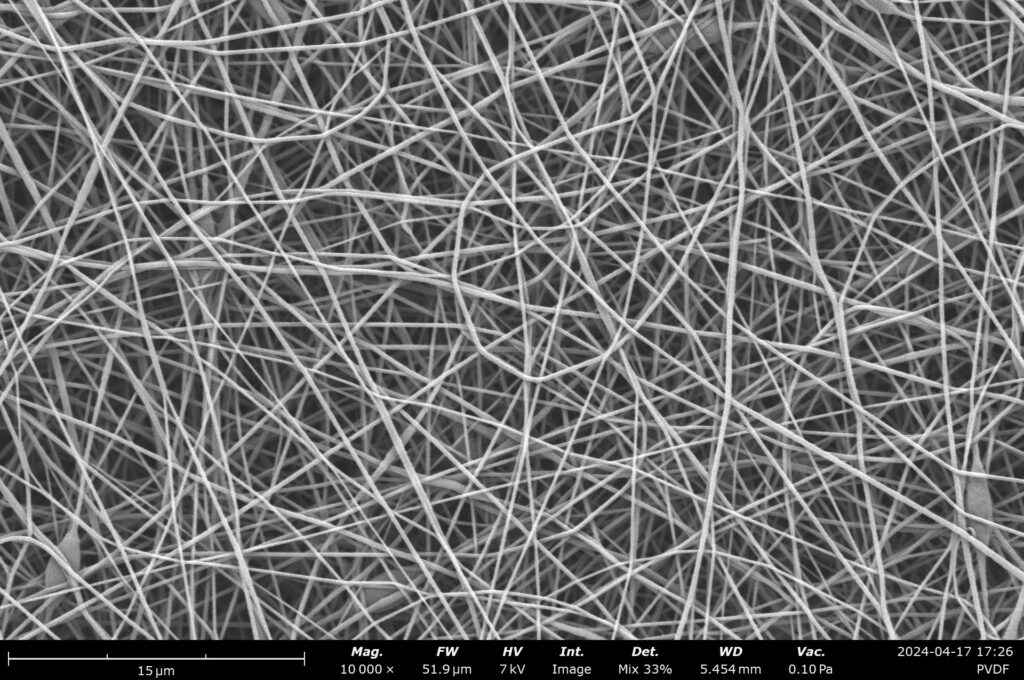
SEM image of PVDF electrospun nanofibers. Image credit: Nanoscience Instruments.
Why Use Electrospun Nanofibers for Piezoelectric Applications?
Electrospinning is a high-voltage fiber fabrication technique capable of producing continuous fibers with diameters ranging from micrometers down to tens of nanometers. The process offers several intrinsic advantages for electrospun piezoelectric nanofibers:
- Enhanced β-Phase Formation
During electrospinning, strong electric fields and extensional forces align polymer chains along the fiber axis. In PVDF-based systems, this promotes the formation of the electroactive β-phase, which is responsible for piezoelectric behavior. Electrospinning can substantially increase β-phase content compared to conventional film casting, often reducing or eliminating the need for extensive post-poling treatments (Li & Xia, 2004; Persano et al., 2013).
- High Surface-to-Volume Ratio
Nanofibrous mats exhibit large interfacial areas and low bending stiffness. These characteristics enhance mechanical sensitivity and strain-induced polarization, improving voltage output under small deformations.
- Mechanical Flexibility
Electrospun membranes are lightweight and flexible, making them ideal for piezoelectric textiles, wearable patches, flexible sensors, and autonomous biomedical devices.
- Structural Tunability
Electrospinning enables precise control over fiber diameter, fiber alignment, porosity, multilayer architectures, and composite incorporation (e.g., ceramic nanoparticles). This versatility supports the development of nanofiber-based piezoelectric devices optimized for specific mechanical environments.
For related insights into functional fiber development, visit: https://fluidnatek.com/
Piezoelectric Nanogenerators from Electrospun Fibers
Electrospun fibers can be integrated into flexible device architectures where mechanical deformation induces charge separation. A typical configuration includes an electrospun PVDF or PVDF-TrFE nanofiber mat, top and bottom conductive electrodes, and an encapsulation layer for mechanical protection. Under cyclic bending or compression, the aligned dipoles generate alternating voltage output.
Key performance parameters include open-circuit voltage (Voc), short-circuit current (Isc), power density (µW/cm²), mechanical durability, and frequency response.
Electrospun architectures are particularly advantageous for low-frequency biomechanical energy harvesting (e.g., walking, breathing, joint motion), making them suitable for wearable energy harvesting systems.
Using PVDF and PVDF-TrFE for Energy Harvesting
PVDF nanofibers are the benchmark material in polymer-based piezoelectric systems. Their advantages include high β-phase stabilization under electrospinning, good chemical resistance, mechanical durability, and commercial availability.
PVDF-TrFE further enhances performance due to its intrinsically higher ferroelectric phase content and reduced need for post-processing. Electrospun PVDF-TrFE nanofiber generators typically show improved polarization stability and enhanced output compared to pure PVDF systems (Chang et al., 2010).
In particular, Persano et al. (2013) demonstrated that aligned arrays of electrospun PVDF-TrFE nanofibers can achieve exceptional piezoelectric performance, enabling pressure sensing down to 0.1 Pa and suitability for both energy harvesting and self-powered sensing applications. Aligned fibers exhibit substantially higher piezoelectric output than randomly oriented mats, a finding confirmed across multiple independent studies, as the higher orientation degree accelerates charge transfer along the fiber axis (Persano et al., 2013).
Optimization strategies include controlling solvent systems to tailor crystallinity, adjusting applied voltage and collector distance, using rotating collectors for fiber alignment, and incorporating ceramic fillers (e.g., BaTiO₃ nanoparticles).
Wearable and Autonomous Power Sources with Nanofibers
The integration of electrospun piezoelectric membranes into textiles enables the development of piezoelectric textiles capable of converting body motion into electricity.
Applications include self-powered health monitoring patches, motion detection systems, flexible pressure sensors, and autonomous IoT nodes. Electrospun nanofiber mats can be laminated onto fabrics or directly integrated into multilayer textile architectures. Their mechanical conformity ensures minimal discomfort while maintaining functional output.
For additional insights into smart textile fabrication, see: https://fluidnatek.com/functionalized-fabrics-electrospinning/
Materials and Fabrication Strategies
The performance of electrospun PVDF systems depends strongly on processing parameters. The α→β phase transformation in PVDF—the key transition responsible for piezoelectric activity—is influenced by both mechanical and electrical conditions during fiber formation (Sencadas et al., 2009).
Polymer Solution Parameters
Concentration affects fiber uniformity and bead formation. Solvent volatility influences crystallinity. Additives can modify conductivity and phase behavior.
Electrospinning Parameters
Applied voltage, flow rate, needle-to-collector distance, and ambient humidity and temperature all play critical roles in determining fiber morphology and β-phase content.
Post-Treatments
Thermal treatment promotes crystalline growth, whereas electrostatic poling and mechanical drawing are critical for aligning molecular dipoles and polymer chains orientation. The uniaxial stretching of PVDF films has been documented as a key method for driving the α→β transition (Sencadas et al., 2009), and electrospinning replicates this effect at the fiber scale during the spinning process itself.
Composite Systems
To enhance dielectric and piezoelectric properties, researchers incorporate BaTiO₃ nanoparticles, ZnO nanostructures, and graphene derivatives. Such hybrid systems aim to combine polymer flexibility with ceramic piezoelectric coefficients, increasing output power without sacrificing mechanical compliance.
Performance in Energy Harvesting Applications
Performance metrics in electrospun piezoelectric power generation systems depend on device architecture and testing conditions.
Wang and Song (2006) demonstrated the foundational concept of nanoscale piezoelectric generators using zinc oxide nanowire arrays. Subsequent research has refined polymer-based systems to improve scalability and flexibility.
Persano et al. (2013) reported high-performance flexible devices based on aligned PVDF-TrFE nanofiber arrays capable of detecting pressures as low as 0.1 Pa, demonstrating the suitability of these architectures for both energy harvesting and ultra-sensitive pressure sensing applications. In flexible configurations, electrospun nanofibers have shown stable output over thousands of mechanical cycles, with voltage outputs spanning from a few volts to tens of volts and power densities typically in the µW/cm² range depending on architecture, fiber alignment, and mechanical input frequency in many reported devices (Persano et al., 2013; Chang et al., 2010).
Electrospun architectures are particularly well-suited for:
- Low-frequency biomechanical energy capture
- Integration with flexible electronics
- Hybrid energy harvesting (combined piezoelectric + triboelectric systems)
Importantly, electrospinning offers scalability from laboratory R&D to pilot and industrial production, enabling translation from academic prototypes to commercial devices.
Fluidnatek’s Capabilities for Piezoelectric Nanofiber Development
Fluidnatek provides advanced electrospinning platforms specifically designed for research, pilot-scale production, and industrial manufacturing of functional nanofibers.
The precise high-voltage control offered by Fluidnatek systems directly supports the β-phase promotion mechanisms described above, while rotating and patterned collectors enable the fabrication of aligned nanofiber architectures that, as Persano et al. (2013) demonstrated, are critical for maximizing piezoelectric output. Environmental control of humidity and temperature during spinning addresses the process-sensitive crystallization behavior of PVDF documented by Sencadas et al. (2009).
Key capabilities include:
- Precise voltage and environmental control
- Multi-needle and needleless configurations
- Rotating and patterned collectors for fiber alignment
- Scalable systems for continuous production
- Compatibility with PVDF and PVDF-TrFE systems
These systems support development of flexible piezoelectric materials, optimization of fiber morphology, fabrication of aligned nanofiber membranes, and scale-up of nanofiber-based piezoelectric devices. Fluidnatek equipment enables reproducibility, process monitoring, and parameter control essential for advanced materials research.
Explore Fluidnatek’s electrospinning solutions: https://fluidnatek.com/electrospinning-machines/
Conclusion
The multidisciplinary convergence of flexible electronics, wearable technologies, and autonomus sensor systems has intensified the development of miniaturized, high-efficiency energy harvesting strategies. Electrospun piezoelectric generators represent a pivotal advancement in this domain, integrating breakthroughs in material science and nanotechnology with scalable manufacturing. By leveraging electrospinning, researchers can enhance β-phase formation, tailor fiber alignment, and fabricate high-performance PVDF and PVDF-TrFE nanogenerators suitable for real-world applications. The resulting systems support wearable energy harvesting, smart textiles, and self-powered sensing platforms.
As demand for flexible, lightweight, and sustainable power sources grows, electrospun nanofiber architectures will play an increasingly strategic role in next-generation energy systems.
Ready to Create Next-Generation Piezoelectric Materials?
Fluidnatek provides scalable electrospinning solutions for energy harvesting nanofiber systems designed for innovation in wearables and autonomous sensors. Whether your focus is PVDF-TrFE fiber alignment, composite nanogenerators, or piezoelectric textile integration, our team can support your process from lab to production scale.
Contact our team to develop your next electrospun piezoelectric nanogenerator platform.
References
Chang, C., Tran, V. H., Wang, J., Fuh, Y. K., & Lin, L. (2010). Direct-write piezoelectric polymeric nanogenerator with high energy conversion efficiency. Nano Letters, 10(2), 726–731. https://doi.org/10.1021/nl903612n
Li, D., & Xia, Y. (2004). Electrospinning of nanofibers: Reinventing the wheel? Advanced Materials, 16(14), 1151–1170. https://doi.org/10.1002/adma.200400719
Persano, L., Dagdeviren, C., Su, Y., Zhang, Y., Girardo, S., Pisignano, D., Huang, Y., & Rogers, J. A. (2013). High performance piezoelectric devices based on aligned arrays of nanofibers of poly(vinylidenefluoride-co-trifluoroethylene). Nature Communications, 4, 1633. https://doi.org/10.1038/ncomms2639
Sencadas, V., Gregorio, R., & Lanceros-Méndez, S. (2009). α to β phase transformation and microstructural changes of PVDF films induced by uniaxial stretch. Progress in Polymer Science, 34(10), 1003–1033. https://doi.org/10.1016/j.progpolymsci.2009.05.004
Wang, Z. L., & Song, J. (2006). Piezoelectric nanogenerators based on zinc oxide nanowire arrays. Science, 312(5771), 242–246. https://doi.org/10.1126/science.1124005


 ESP
ESP