


Introduction: The Challenge of Thermal Separation Processes
Water desalination, wastewater treatment, and resource recovery all depend on efficient separation technologies capable of producing high-purity water while minimizing energy consumption. Among the emerging approaches being investigated, membrane distillation has attracted significant interest because it combines high salt rejection with relatively low operating temperatures. This makes it a promising technology for advanced water treatment applications.
The efficiency of membrane distillation depends strongly on membrane structure and surface chemistry. Parameters such as porosity, pore size distribution, pore tortuosity, thickness, and hydrophobicity directly influence vapor transport and heat transfer resistance.
In recent years, electrospun membranes for membrane distillation have been extensively investigated because electrospinning enables the fabrication of highly porous nanofiber structures with interconnected pore networks. These architectures can facilitate vapor diffusion while maintaining separation between the feed and permeate streams.
As a result, electrospun nanofiber membrane distillation systems are becoming an increasingly important research area in advanced water treatment and separation science.
What Is Membrane Distillation?
Membrane distillation is a thermally driven membrane separation process in which a hydrophobic semipermeable membrane separates a heated feed solution from a colder permeate side.
The process operates through a vapor pressure gradient generated by a temperature difference across the membrane. Water evaporates at the interface between the warm feed and the membrane, and the vapors diffuse through the membrane pores and condense at the colder permeate side.
Because the membrane is hydrophobic, liquid water is prevented from penetrating the pores, resulting in selective vapor transport.
The performance of membrane distillation membranes depends on several key parameters:
- Membrane porosity
- Pore size distribution
- Membrane thickness
- Thermal conductivity
- Hydrophobicity
- Pore tortuosity
These factors influence vapor flux, conductive heat loss, liquid entry pressure (LEP; the maximum working pressure for the membrane distillation process, above which liquid water would penetrate the membrane), and long-term operational stability.
Traditionally, membrane distillation membranes are designed with relatively high thicknesses to reduce conductive heat transfer between the feed and permeate streams. However, thicker membranes may also increase the resistance to vapor transport, thus reducing the vapor flux.
Consequently, membrane engineering for distillation requires balancing thermal insulation with efficient vapor transport.
Electrospun Membranes for Membrane Distillation
Electrospinning is a versatile fabrication technology capable of producing continuous nanofibers from polymer solutions using a strong electric field.
Electrospun nanofiber membranes typically exhibit:
- High surface-area-to-volume ratio
- High porosity
- Interconnected pore structures
- Tunable fiber diameters
These structural characteristics are advantageous for membrane distillation because they can facilitate vapor diffusion.
At the same time, electrospun membranes must maintain sufficient hydrophobicity to prevent membrane wetting during operation.
Research has demonstrated that fiber morphology significantly influences membrane wetting behavior and vapor transport performance.
However, smoother fibers may sometimes provide higher vapor flux because of differences in pore interconnectivity and membrane packing density.
These observations highlight the importance of carefully balancing:
- Fiber morphology
- Hydrophobicity
- Porosity
- Mechanical stability
- Liquid entry pressure
when designing electrospun membranes for distillation applications.
Hydrophobic Nanofibers for Efficient Vapor Transport
Hydrophobicity is one of the most critical parameters in membrane distillation systems. If pore wetting occurs (i.e., if liquid water penetrates the membrane pores), the feed and permeate solutions come in direct contact with each-other, resulting in contamination of the permeate stream. This scenario is considered a critical failure of the membrane.
Electrospun poly (vinylidene fluoride) (PVDF) membranes have been widely investigated in the context of membrane distillation due to their intrinsic hydrophobicity, chemical resistance, and thermal stability.
Experimental studies have shown that electrospun PVDF membranes can achieve relatively high vapor permeation fluxes. However, electrospun structures often exhibit lower liquid entry pressure than commercial PTFE membranes, meaning the risk of pore wetting is higher.
For example, reported studies observed that electrospun PVDF membranes exhibited liquid entry pressure (LEP) values below 0.64 bar, whereas commercial PTFE membranes demonstrated substantially higher LEP values of approximately 9 bar. The relatively low LEP of the electrospun PVDF membranes indicated a greater susceptibility to pore wetting under pressure-driven conditions, although these membranes often exhibited higher vapor flux due to their highly porous nanofibrous structure.
Despite this limitation, electrospun PVDF membranes have demonstrated higher vapor flux in certain membrane distillation configurations due to their highly porous nanofibrous architecture.
These findings indicate that electrospun nanofiber membranes may offer important mass transport advantages, although long-term wetting resistance remains an active area of research.
Materials and Design Strategies for High-Performance Membranes
Polymer Selection for Membrane Distillation
The polymer used during electrospinning strongly influences membrane performance in membrane distillation applications.
Materials commonly investigated include:
- Polyvinylidene fluoride (PVDF)
- Polyurethane (PU)
- Polystyrene (PS)
- Polysulfone (PSU)
- PVDF-HFP copolymers
These polymers differ in:
- Hydrophobicity
- Thermal stability
- Mechanical resistance
- Solvent compatibility
- Processability
Experimental studies with electrospun polyurethane (PU) membranes demonstrated that membrane thickness and feed salinity significantly influence permeation flux. In the work reported by Feng, Khayet, and Matsuura in their study on electrospun nanofibrous membranes for membrane distillation, thin electrospun membranes (approximately 6–10 g m⁻²) achieved fluxes above 10 kg m⁻² h⁻¹ under the experimental conditions reported by the authors and at feed salinities below 20 wt. % NaCl.
As feed salinity increased, flux progressively decreased to approximately 8 kg m⁻² h⁻¹, highlighting the impact of concentration polarization and membrane wetting phenomena on membrane distillation performance. In contrast, thicker electrospun membranes exhibited lower but more stable flux values, typically between 6 and 8 kg m⁻² h⁻¹ across the tested salinity range.
The lower stability of thinner membranes was associated with larger pore sizes and lower bubble-point pressures, increasing susceptibility to membrane wetting.
Surface Engineering and Hydrophobic Modification
Several surface engineering strategies have been investigated to improve hydrophobicity and wetting resistance in electrospun membranes.
One reported approach involved electroless silver plating followed by 1-dodecanethiol surface modification of electrospun PVDF nanofibers. The resulting membrane achieved:
- Water contact angle ≈153°
- Sliding angle <10°
Under the reported experimental conditions, the modified membrane maintained a relatively stable vapor flux during eight hours of membrane distillation testing.
Other studies (Zhou et al. (2014) have reported PTFE nanofibrous membranes fabricated by electrospinning PTFE/PVA precursor suspensions followed by high-temperature sintering. In this approach, PVA acts as a carrier polymer during electrospinning, while the PTFE particles are subsequently fused during thermal treatment to generate a nanofibrous PTFE structure.
These membranes demonstrated:
- Water contact angle ≈156.7°
- Salt rejection >98 %
during vacuum membrane distillation experiments.
Such approaches illustrate how membrane surface engineering can improve wetting resistance and operational stability in membrane distillation systems.
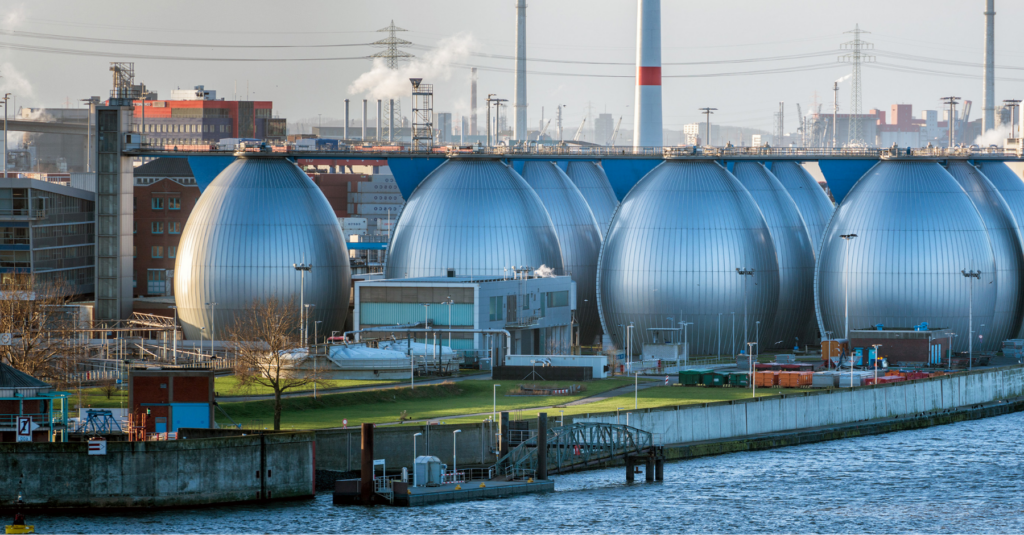
Desalination plant in Germany.
Performance and Efficiency Advantages
Nanofiber Membranes for Desalination and Water Treatment
Several experimental studies have evaluated electrospun membranes in desalination and water purification applications.
One investigation involving electrospun polysulfone nanofibers modified with beeswax reported:
- Water contact angle ≈162°
- Salt rejection >99.8 %
- Permeate flux ≈6.4 L m⁻² h⁻¹
during direct contact membrane distillation testing with sodium chloride feed solution.
The membrane exhibited relatively stable operation over extended testing periods, with only moderate flux decline reported after prolonged operation.
These results demonstrate the potential of electrospun membranes for advanced water treatment applications where high salt rejection and controlled vapor transport are required.
Multi-Layer Membrane Architectures
To improve wetting resistance and liquid entry pressure, researchers have explored multilayer membrane designs.
One reported configuration included:
- Hydrophilic nanofiber support layer
- Cast membrane intermediate layer
- Superhydrophobic electrospun PVDF top layer
In this structure:
- The superhydrophobic layer reduces pore wetting
- The intermediate layer increases liquid entry pressure
- The hydrophilic support assists vapor transport
Under reported experimental conditions, the membrane maintained stable permeation performance over extended operating periods while preserving high salt rejection.
Influence of Fiber Architecture
Recent studies have also investigated electrospun membranes containing bimodal fiber diameter distributions.
These structures combine fibers of different diameters within the same membrane, modifying pore architecture and vapor transport pathways.
Research involving PS, PVDF-HFP, and blended systems reported permeation fluxes up to approximately 43.41 L m⁻² h⁻¹ while maintaining salt rejection near 99.74%.
These findings suggest that fiber diameter distribution and structural organization may significantly influence membrane distillation performance.
Fluidnatek’s Role in Electrospun Membrane Development and Scale-Up
Advanced electrospinning equipment plays an important role in the development of nanofiber membranes for membrane distillation and thermal separation technologies.
Fluidnatek electrospinning platforms support controlled fabrication of nanofiber membranes by enabling adjustment of:
- Fiber diameter
- Membrane thickness
- Porosity
- Polymer solution formulation
- Multi-layer architecture
Such process control capabilities are relevant for researchers investigating membrane distillation, desalination membranes, hydrophobic nanofiber systems, and advanced filtration materials.
Fluidnatek platforms also support process scalability from laboratory development toward pilot-scale and even full-scale manufacturing configurations, which is an important consideration for membrane technology translation.
Conclusion
Membrane distillation is an important emerging technology for desalination and water treatment.
Electrospun membranes for membrane distillation offer several potential advantages, including:
- High porosity
- Tunable nanofiber structures
- Enhanced vapor transport
- Flexible membrane architecture design
At the same time, challenges related to pore wetting and long-term hydrophobic stability remain active areas of scientific research.
Ongoing developments in polymer engineering, multilayer membrane architecture, and surface modifications continue to improve the performance of electrospun nanofiber membranes for distillation applications.
Although many of these technologies are still at the research and pilot scale, electrospinning is expected to play an increasingly important role in next-generation membrane distillation systems.
Accelerate Membrane Distillation Research with Fluidnatek
Looking to develop high-performance membranes for distillation and advanced separation technologies?
Fluidnatek’s electrospinning platforms support the development of customizable nanofiber membranes for membrane distillation, desalination research, filtration, and other water treatment applications.
Contact Fluidnatek’s technical team to explore scalable electrospinning solutions for membrane engineering and thermal separation research.
References
ElectrospinTech. Electrospun membrane for distillation.
http://electrospintech.com/memdistillation.html
Essalhi, M., & Khayet, M. (2014). Surface modification of electrospun PVDF membranes for membrane distillation. Desalination.
Liao, Y., et al. (2013). Superhydrophobic modification of electrospun PVDF nanofibers for membrane distillation.
Zhou, X., et al. (2014). Electrospun PTFE nanofiber membranes for vacuum membrane distillation.
Prince, J. A., et al. (2014). Triple-layer membranes for improved membrane distillation performance.
Zhao, S., et al. (2023). Bimodal fiber diameter electrospun membranes for membrane distillation.
Khayet, M., & Matsuura, T. (2011). Membrane Distillation: Principles and Applications. Elsevier.
Feng, C., Khayet, M., & Matsuura, T. Preparation and Characterization of Electrospun Nanofibrous Membranes for Membrane Distillation. In: Membrane Distillation: Principles and Applications. Elsevier.


 ESP
ESP