



Introduction: Enhancing Implant–Tissue Interactions
The long-term performance of biomedical implants is fundamentally determined by the biological response at the implant–tissue interface. Regardless of the bulk material used—metallic, polymeric, or composite—the surface in contact with host tissue governs protein adsorption, immune activation, cellular adhesion, and ultimately tissue remodeling. Suboptimal interface properties can result in persistent inflammation, fibrous encapsulation, or postoperative adhesions, compromising both functional outcomes and patient recovery.
In recent years, electrospun nanofiber membranes have emerged as promising candidates for engineering implant interface layers. Their structural resemblance to the extracellular matrix (ECM), combined with tunable surface chemistry and degradability, enables controlled modulation of cell–material interactions.
A recent study by Ren et al. (2023) investigated electrospun polycaprolactone (PCL)/polyethylene glycol (PEG) membranes as implant interface layers. By varying PEG content, the authors tailored membrane hydrophilicity and evaluated its influence on macrophage response in vitro and adhesion formation in vivo using a rat Achilles tendon injury model. Surface hydrophilicity emerged as a key factor in attenuating inflammatory signaling and optimizing tissue-implant integration
This article examines electrospun fibers as implant interface layers, focusing on their biological rationale, material strategies, translational relevance, and fabrication considerations within the biomedical context.
What Are Implant Interface Layers and Why Do They Matter?
An implant-tissue interface serves as a functionalized interlayer or biomimetic scaffold engineered to modulate the bidirectional biological signaling between a prosthetic device and surrounding tissue. Evolving beyond inert coatings, these architectures now function as bioactive modulators that influence the acute immune response and subsequent long-term homeostatic integration
Key biological processes occurring at the implant interface include:
- Adsorption of serum proteins
- Recruitment and activation of immune cells
- Macrophage polarization dynamics
- Fibroblast migration and extracellular matrix deposition
- Fibrotic encapsulation or adhesion formation
Macrophages play a central role in determining the fate of implanted materials. Their polarization toward a pro-inflammatory (M1-like) or pro-regenerative (M2-like) phenotype significantly influences healing outcomes. Excessive or prolonged M1 activation is associated with chronic inflammation and fibrosis, whereas M2 polarization supports tissue repair and remodeling.
In the study by Ren et al., bone marrow-derived macrophages (BMDMs) cultured on electrospun PCL/PEG membranes exhibited hydrophilicity-dependent responses. Increasing PEG content enhanced membrane hydrophilicity and was associated with down-regulation of inflammatory gene expression and increased expression of markers linked to M2-like polarization. These results demonstrate that surface wettability can meaningfully influence immune cell behavior.
In vivo evaluation using a rat model further demonstrated that pure PCL membranes were associated with substantial adhesion formation, whereas PCL/PEG membranes showed reduced adhesion and facilitated easier separation of tendon from surrounding tissue. The membrane containing the highest PEG ratio exhibited the lowest inflammatory response and fewest adhesions among the tested groups.
Electrospun nanofibers are thus repositioned as bioactive transducers capable of governing tissue-to-implant integration, moving beyond the concept of static anatomical barriers
Electrospun Nanofibers for Implant–Tissue Integration
Electrospinning produces continuous fibers with diameters typically in the nano- to submicron range, forming porous, interconnected membranes. Several characteristics make electrospun nanofibers particularly attractive as implant interface layers.
Advantages of Fibrous Biointerfaces
- ECM-Mimetic Architecture
The fibrous morphology of electrospun membranes resembles native extracellular matrix, providing topographical cues that influence cell adhesion and morphology. This structural similarity can facilitate more physiological cell–material interactions compared to smooth or minimally textured surfaces.
- High Surface Area and Porosity
Electrospun mats present large surface areas for protein adsorption and cell contact, while their interconnected porosity supports nutrient diffusion and cellular infiltration where desired.
- Tunable Surface Chemistry
By blending polymers with different physicochemical properties, such as hydrophobic PCL and hydrophilic PEG, membrane wettability and degradation behavior can be adjusted. In the Ren et al. study, increasing PEG content directly modulated hydrophilicity and altered macrophage responses.
- Controlled Degradation
The study noted that membranes with higher PEG content exhibited a sparser multilayer structure in vivo, which may be related to faster degradation and potentially facilitated tissue separation at the membrane layer. This observation suggests that degradation kinetics can influence adhesion formation and interface remodeling.
Materials Used and Functionalization Strategies
H3 PCL/PEG Blended Systems
Polycaprolactone (PCL) is a widely used biodegradable polyester known for its mechanical flexibility and slow hydrolytic degradation.
Nevertheless, its inherent hydrophobicity frequently leads to non-specific protein adsorption, which may trigger adverse pro-inflammatory responses.
Polyethylene glycol (PEG), in contrast, is hydrophilic and widely used to enhance surface wettability and reduce non-specific protein adsorption. By blending PEG with PCL prior to electrospinning, Ren et al. created membranes with tunable hydrophilicity while maintaining structural integrity.
The study demonstrates that increasing PEG content:
- Enhances hydrophilicity
- Reduces inflammatory gene expression in macrophages
- Promotes M2-like polarization
- Reduces adhesion formation in vivo
Importantly, the investigation did not rely on additional bioactive molecules or drug incorporation; the modulation effect was achieved solely through adjustment of polymer composition and resulting surface properties.
Role of Fiber Alignment
The membranes in the study were described as aligned nanofibers. Fiber alignment can influence cell orientation and migration, particularly in musculoskeletal applications where anisotropic tissue architecture is critical. While the study focuses primarily on hydrophilicity effects, alignment may contribute to guiding tissue organization at the interface.
Considerations for Surface Modification
Beyond polymer blending, electrospinning platforms allow additional strategies such as incorporation of bioactive agents or post-fabrication surface treatments. However, the Ren et al. work specifically highlights that even without complex biochemical functionalization, physicochemical modulation alone can significantly alter immune response and adhesion outcomes.
Applications and Clinical Relevance
Tendon Repair and Adhesion Prevention
Postoperative adhesions remain a major complication in tendon surgery, limiting mobility and functional recovery. In the rat Achilles tendon injury model used by Ren et al., pure PCL membranes were associated with substantial tissue adhesion. In contrast, PCL/PEG membranes reduced adhesion formation, and the highest PEG ratio yielded the most favorable outcome in terms of reduced inflammation and improved tissue separation.
These findings suggest that electrospun implant interface layers may serve as physical and biological barriers that minimize pathological fibrotic bridging while supporting controlled healing.
Broader Implications for Implant–Tissue Integration
Although the study specifically evaluates a tendon model, the underlying principle—modulation of macrophage phenotype through surface hydrophilicity—has broader implications for other soft tissue implant applications. However, extrapolation to orthopaedic hard-tissue implants or cardiovascular devices requires dedicated experimental validation.
The work supports a paradigm in which implant surface engineering prioritizes immune modulation as a primary design objective.
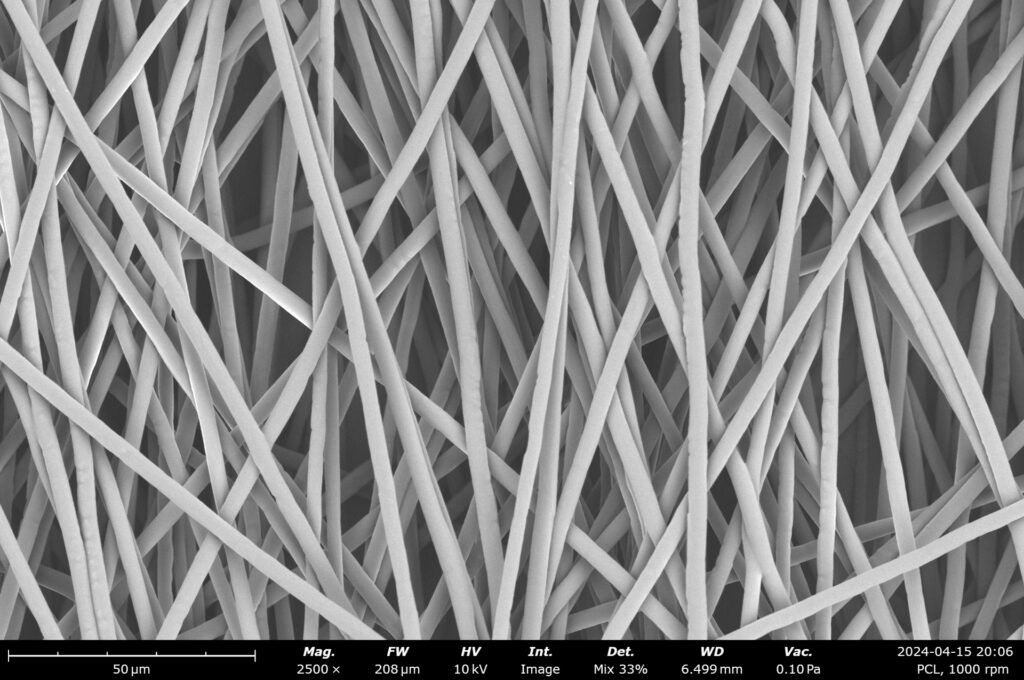
PCL aligned fibers made at 1000 rpm. Image credit: Nanoscience Instruments.
Fluidnatek’s Capabilities in Implant Interface Nanofiber Development
Translating preclinical findings into practical biomedical applications requires reproducible fabrication platforms capable of controlling fiber morphology, alignment, and polymer composition.
Fluidnatek provides electrospinning systems designed to support:
- Precise control of polymer blending (e.g., PCL/PEG ratios)
- Fabrication of aligned nanofiber membranes
- Reproducible control over fiber diameter and morphology
- Development of degradable fibrous interface layers
Such platforms enable research teams to replicate and extend experimental configurations similar to those described by Ren et al., facilitating systematic studies on implant–tissue integration and immune modulation.
More information on electrospinning platforms for biomedical research is available at: https://fluidnatek.com/electrospinning-machines/
Conclusion: Toward Immunomodulatory Implant Interfaces
Electrospun fibers as implant interface layers represent a strategic evolution in biomedical surface engineering. Rather than functioning solely as passive structural coatings, these nanofiber membranes can actively influence early immune responses and subsequent tissue remodeling.
The study by Ren et al. demonstrates that tuning hydrophilicity through PCL/PEG blending modulates macrophage gene expression and reduces adhesion formation in a rat tendon injury model. Increased PEG content correlated with reduced inflammatory signaling, enhanced M2-like polarization, and fewer postoperative adhesions. Additionally, higher PEG ratios were associated with structural changes consistent with faster degradation, which may facilitate tissue separation at the interface.
These findings reinforce the concept that surface chemistry and nanoscale architecture are central determinants of implant performance. Continued investigation into electrospun nanofiber interface layers may advance the development of next-generation biomedical implants designed not only for mechanical function, but also for precise biological integration.
References
Ren, Y., et al. (2023). Electrospun fibers as implant interface layer. ElectrospinTech. Retrieved from http://electrospintech.com/implantinterface.html
Zhang, X., Liu, L., Wang, Y., & Chen, H. (2021). Electrospun nanofiber scaffolds in regenerative medicine. Acta Biomaterialia, 134, 123–140. https://doi.org/10.1016/j.actbio.2021.04.010
Li, Q., Yang, J., Zhao, Y., & Wang, L. (2020). Electrospun nanofibers as implant coatings for tissue regeneration. Journal of Biomedical Materials Research Part A, 108(9), 1834–1845.


 ESP
ESP